Understanding DORA and Its Implications for IT Leaders
The Digital Operational Resilience Act (DORA) is a regulatory framework established by the European Union to enhance the resilience of financial institutions and their third-party IT service providers. The regulation, which takes effect in January 2025, mandates stringent requirements in areas such as ICT risk management, incident reporting, and third-party risk oversight.
For Chief Information Officers (CIOs) and Chief Technology Officers (CTOs) in financial institutions, DORA presents significant challenges, requiring robust operational resilience strategies, continuous monitoring, and secure IT integration with external providers.
For more details on DORA, refer to the following sources:
Key Challenges CIOs and CTOs Face with DORA Compliance
1. Managing Third-Party IT Risks
- Financial institutions rely on multiple external IT providers (e.g., cloud services, SaaS platforms, FinTech solutions).
- Ensuring that these third parties comply with DORA’s resilience requirements is complex and requires continuous monitoring.
2. Incident Detection and Recovery
- DORA mandates that institutions must restore critical IT functions within two hours following an incident.
- Proactive risk management and real-time monitoring are essential for compliance.
3. Data Management and Regulatory Reporting
- CIOs must ensure accurate data collection, transformation, and reporting to regulators.
- Lack of centralized data orchestration can lead to compliance failures.
4. Cybersecurity and API Governance
- Financial organizations must secure APIs, enforce access controls, and prevent data breaches.
- Compliance with zero-trust principles and API security best practices is critical.
5. Testing and Operational Readiness
- Institutions need robust disaster recovery and penetration testing to prove operational resilience.
- Ensuring continuous performance testing across all IT services is a significant challenge.
How MuleSoft Helps CIOs and CTOs Address DORA Compliance Challenges
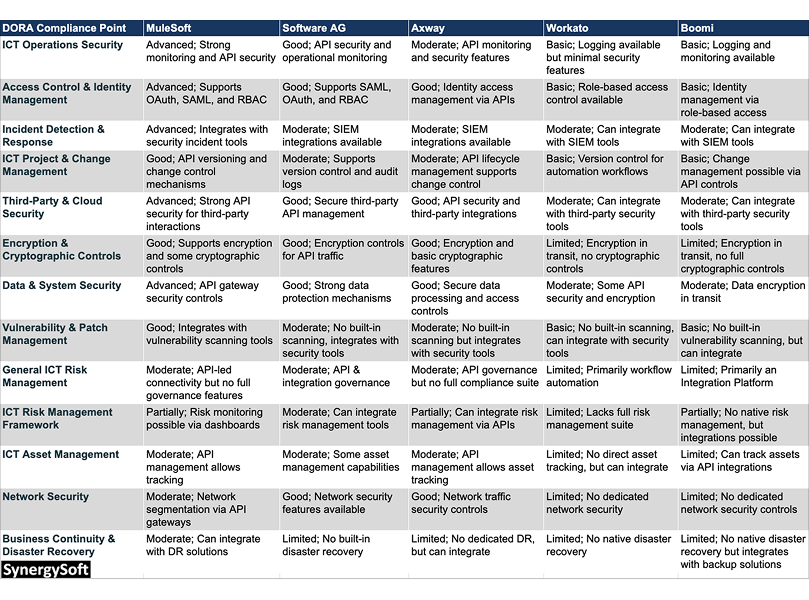
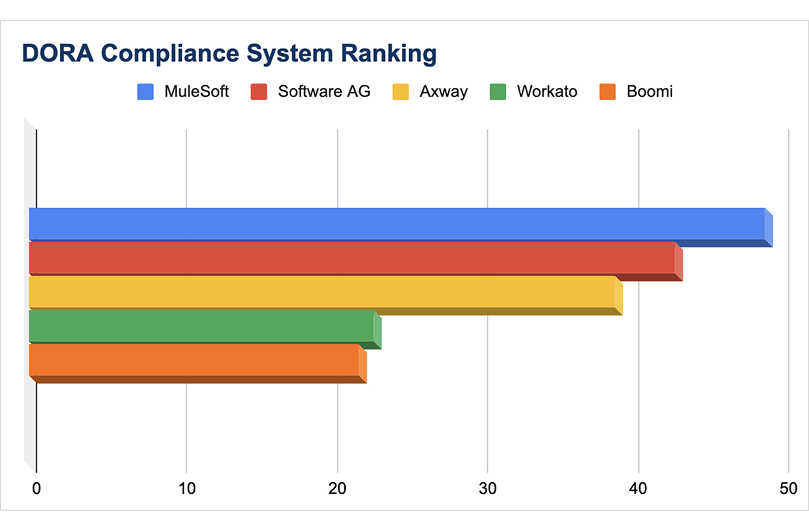
At SynergySoft, we conducted a comprehensive comparison of different integration platforms to assess their compliance capabilities concerning DORA requirements. The results are summarized in the following table:
MuleSoft as a Compliance Accelerator
MuleSoft provides the integration backbone for financial institutions to comply with DORA faster by:
1. Streamlining Third-Party IT Risk Management
MuleSoft’s API-led connectivity provides a centralized, secure integration layer that enables CIOs and CTOs to:
- Standardize interactions with third-party service providers.
- Implement real-time monitoring for vendor performance and risk assessment.
- Ensure auditability and traceability of third-party services.
2. Enabling Real-Time Incident Detection and Recovery
MuleSoft facilitates event-driven architecture and automated response workflows, ensuring:
- Immediate incident detection through integration with IT monitoring tools (e.g., Splunk, Dynatrace, ServiceNow).
- Automated failover and backup switching to meet DORA’s two-hour recovery requirement.
- End-to-end visibility into IT operations for rapid root-cause analysis.
3. Automating Regulatory Reporting and Data Management
With MuleSoft’s Anypoint Platform, organizations can:
- Aggregate data from multiple systems and standardize it for compliance reporting.
- Automate data submissions to regulatory authorities, reducing manual errors.
- Improve data governance and transparency for audits.
4. Enhancing API Security and Governance
DORA compliance demands secure data flows and third-party access controls. MuleSoft enables:
- End-to-end API security with OAuth, JWT, and mutual TLS authentication.
- Fine-grained role-based access control (RBAC) to restrict sensitive financial data access.
- Automated compliance enforcement using API policies and threat detection tools.
5. Ensuring Continuous Testing and Operational Readiness
To meet DORA’s resilience testing requirements, MuleSoft provides:
- Built-in resilience testing and automated load balancing to simulate real-world failure scenarios.
- Integration with DevOps tools for continuous security monitoring.
- Automated performance benchmarking for third-party integrations.
- By leveraging MuleSoft’s API-led integration, event-driven capabilities, and automation, financial organizations can accelerate DORA compliance while improving overall digital resilience. 🚀
Technologies we use



Other cases